In April 2026, a study was published examining the psychiatric outcomes of referrals to youth gender services in Finland. This study looked back at all referrals to youth gender services between 1996 and 2019 and assessed the longer term trajectory of those individuals who received medical treatment, in comparison to matched controls.
What this study found was that not only was there a higher rate of serious psychiatric issues in those who were referred to gender services - which increased markedly in the cohort referred after 2010 - but that those who underwent medical treatment also got significantly worse:
Among adolescents who underwent medical gender reassignment, psychiatric morbidity increased markedly during follow-up—rising from 9.8% to 60.7% in feminising gender reassignment and from 21.6% to 54.5% in masculinising gender reassignment.
While this study cannot determine whether treatment caused the deterioration, this is compelling new evidence pointing towards something that critics of paediatric medical transition have long believed: that the weak evidence base and non-existent follow-up of those undergoing treatment was hiding the fact that the outcomes were shockingly poor.
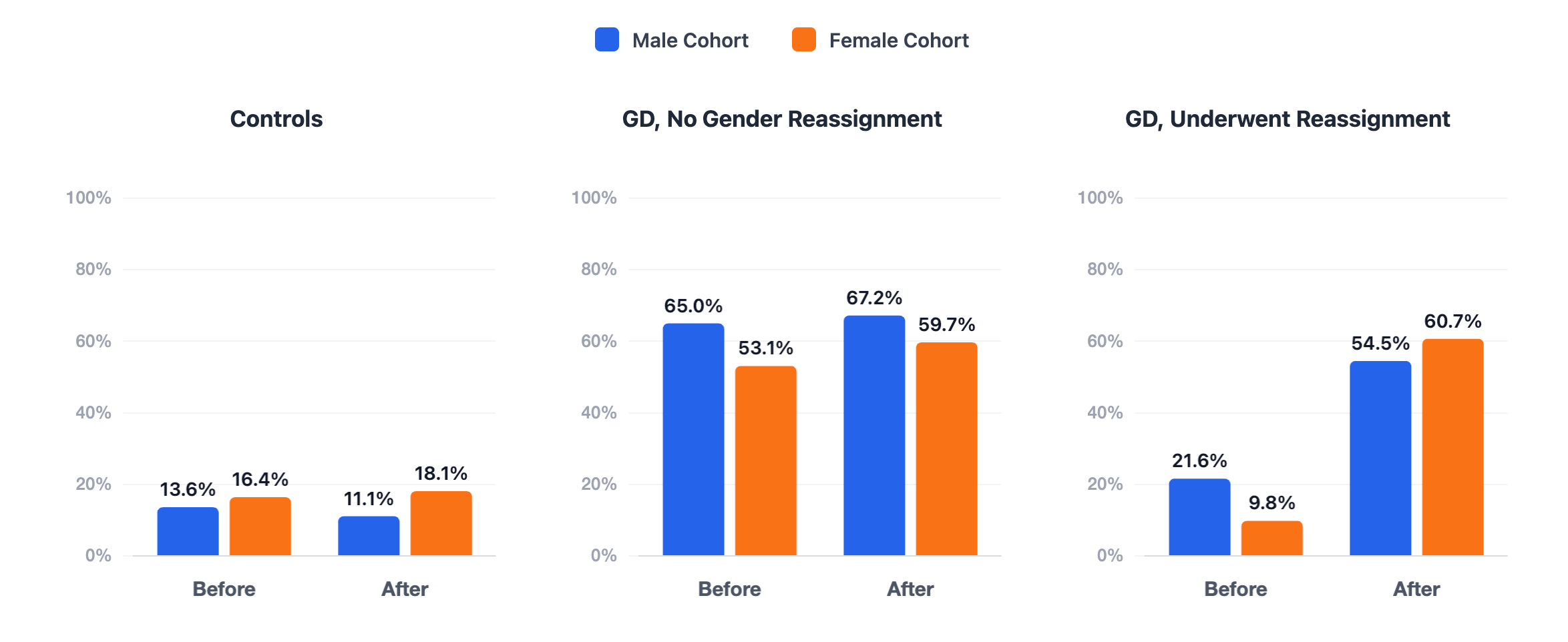
It is also worth noting that, according to this data, those with high rates of pre-existing psychiatric conditions were routinely denied medical transition, ie. the most severe cases were excluded. In this cohort, referral rates remained roughly the same over time, with only a slight increase. This is in contrast to a common assertion that pre-existing conditions are a symptom of untreated gender dysphoria, that psychiatric gatekeeping is harmful, and that it is paramount to provide medical transition on demand in order to prevent suicide.
That the evidence base for these interventions is weak is by now not really in question since the 2024 Cass Review found serious gaps in the evidence and concluded that puberty blockers should not be given outside of clinical trials. In February this year, Hilary Cass gave an interview to the BBC reiterating the need for the forthcoming clinical trial into the effectiveness of puberty blockers for gender-questioning youth. Cass, who has consistently tried to chart a neutral and evidence-based path through this whole debacle, has stuck to the findings in her report: that the evidence base for these interventions is poor, and we need better evidence before proceeding.
In that light, one of the most scandalous outcomes of the Cass Review - and something that has received shockingly little attention - was the refusal of adult clinics to take part in a data linkage study. This would have provided critical long-term follow-up data on children who had passed through GIDS and moved into a different service in adulthood. That this data exists but has been withheld is shocking and surely we should make the best of what already exists before setting out to collect new information. Such a data linkage study could have been completed well before this latest Finnish study and would have given long-term follow-up data on treatment efficacy that could have been informing policy by now.
That a multi-million pound clinical trial on puberty blockers ever got off the ground while adult clinics stonewalled sharing information that might have obviated the need to even conduct the trial in the first place is, frankly, mindblowing.
Two years on from the Cass Review, the data linkage study is still a matter of contention, with Health Secretary Wes Streeting issuing an update demanding the cooperation of the adult clinics.
Interestingly, this lists the bodies affected, namely the adult clinics and their partners who have so far refused to hand over data. Of interest are the following two organisations:
(4) GTD Healthcare Limited is a company registered in England and Wales (registration number 12293359). It is commissioned by NHS England to provide NHS adult gender services, delivered in partnership with the LGBT foundation through Indigo Gender Services.
(5) LGBT Foundation Ltd is a charity registered (registration number 1070904) and a company registered (registration number 03476576) in England and Wales.
Indigo Gender Service was launched in December 2020, as a partnership between LGBT Foundation and GTD Healthcare. Of Indigo Gender Services’ four directors, one is Paul Martin, CEO of LGBT Foundation, and another is Stephen Whittle, director and interim CEO of Translucent, and many other organisations stretching back over decades of activism.
So, a body set up in tandem with activists with a vested interest in a particular worldview, and run by those self-same activists, has so far refused to cooperate with the reasonable request for patient outcome data. To illustrate some of these positions:
LGBT Foundation’s written evidence on GRA reform in 2020 was very concerned about the autonomy of under-16s. They argued that children should be able to self-declare their gender at any age without parental consent as long as they are “Gillick competent” - which is about medical competence. The implication of on-demand medical treatment is already assumed at this stage, even if not said directly.
In June 2021, LGBT Foundation was one of the coalition of lobby groups led by Mermaids and the Good Law Project who attempted to strip LGB Alliance of charitable status for speaking up about the harms of medical transition to LGB youth.
In January 2024, Manchester City Council produced research in partnership with LGBT Foundation which highlighted a key concern was that “Puberty/hormone blockers are very difficult to access.”
In March 2025, LGBT Foundation published a report on working with healthcare organisations to deliver “trans affirmative” care.
This is an organisation that is deeply committed to the medicalisation of children, and it is a scandal that they have been allowed in any way to have a say in whether follow-up data can be scrutinised.
Meanwhile, Translucent - another organisation Stephen Whittle leads - spends its time false-consciousness-raising, spreading medical misinformation, smearing its opponents, trying to prevent any outcome other than medical transition for gender-questioning youth, and trashing the Cass Review.
In one particularly shameless display, Translucent criticises the Cass Review for:
Overstating the extent of Detransitioning: Despite reference to engaging with a wide range of stakeholders and examining the data of 3,306 patients, fewer than ten detransitioners were identified.
The problem with this is that this is what the data linkage study would have given actual numbers on. The data linkage study which was in part blocked by an organisation Stephen Whittle leads. So one organisation Whittle is director of is involved in preventing new evidence coming to light, while another organisation Whittle is director of smears Cass in public for not having that data.
The exact people publicly attacking Cass for not having evidence of detransition rates are the ones hiding that evidence in the first place.
If the data was good, organisations like Indigo would surely be champing at the bit to publish it. Meanwhile connected organisations like Translucent spend their time attacking MPs for sharing an analysis of the data we do actually have, ie. the new Finnish study. We seemingly aren’t allowed to see their data, and we aren’t allowed to look at anyone else’s either, if that data is bad.
I’m sure that caring healthcare professionals would like to believe it is possible to conduct an ethical study that can determine whether or not there is a benefit to giving puberty blockers to children. However, the reasons for doing so in the first place are bound up in decades of activism, and it is impossible to get to the root of why you would even give them in the first place without grappling with the worldview that made this treatment possible.
Whether explicitly stated or not, a whole self-supporting belief system is integral to the “affirmative” model of paediatric transition: that gender identity supersedes sex, that it is innate and immutable, that diagnosing it as a medical condition is pathologising and hateful, that children know who they are, that attempts to understand the roots of a desire to be the opposite sex with exploratory therapy is conversion therapy and should be criminalised, that access to puberty blockers is medically necessary and will prevent suicide, that a surge in adolescent girls with serious mental health issues and comorbidities seeking to become the opposite sex is not a cause for concern but a sign of progress. And on and on.
I believe that - in continuing to support the proposed puberty blocker trial - Hilary Cass wants to take a neutral but compassionate stance, and wants to believe everyone is acting in good faith. This is admirable, and I wish that was the world we live in - but I don’t think she really sees how interconnected the on-demand provision of puberty blockers to children is with decades of wider transactivism, and how the same organisations that have stymied the data linkage study are part and parcel with those attempting to prevent any other approach by any means necessary. The production of weak evidence, the suppression of medical research, and the smearing of anybody who actually tries to draw attention to this or robustly address the gaps in our knowledge have gone hand in hand for years.
Whether or not it is possible to actually have an ethical trial of puberty blockers for gender-questioning youth, I think this is something that really shouldn’t have got off the ground while adult clinics were still refusing to release data, especially when there is every reason now to believe that this is ideologically motivated and hiding poor outcomes. It is not a stretch to think that those who have spent years obfuscating and delaying are pinning their hopes on a new study on puberty blockers providing the institutional cover they need to allow them to continue as before.
In this light, pushing for a new clinical trial feels less like genuine scientific enquiry, and more like a bid for retrospective planning consent. Except instead of trying to get away with an eyesore of an extension, they are trying to cover up the extent of the needless sterilisation of same-sex attracted youth.