"It is difficult to get a man to understand something when his podcast depends on his not understanding it"
- Uptonow Sinclair
In November 2020, Ubisoft updated its game Watch Dogs: Legion to remove in-game podcasts voiced by British journalist, Helen Lewis. The reason for this given at the time was that they became aware (after a furore on Twitter) that she had expressed “controversial remarks” about proposed UK reforms to the Gender Recognition Act (GRA) to enable self-id. As Lewis put it, according to the proposed legislation, “being a woman or a man is now entirely in your head”, which Kotaku described thus:
Statements like this have led many to regard Lewis, a leftist feminist who claims to support trans rights, as a TERF
Another British journalist whose voice was also featured in the game was Ian Dunt, who, to his credit, condemned Ubisoft’s action at the time:
As one of the other voices in the game, let me go on record to say that I’m incensed by this. Whether you agree with Helen’s views on trans issues or not, they are legitimate debate and she is entitled to hold and express them. […] And worst of all, in an anti-fascist game. Wiping away someone’s voice in a software update: the digital equivalent of burning books.
Looking back on Dunt’s intervention here from 2026 it comes across as perhaps a little fence-sitting, taking no actual position on the sex/gender conflict itself, but rather standing up for the liberal principle that Helen Lewis had not gone beyond the bounds of reasonable debate and was undeserving of such draconian cancellation at the behest of an incensed twitter mob. However it is important to stress that, in 2020, it was exceedingly rare for anyone with a public platform to defend even this principle so - fence-sitting or not - at the time, it was a rare instance of a public figure not rushing to condemn “transphobia”. I have no doubt that even a statement like this against such an obvious injustice would have opened him up to some negative pushback.
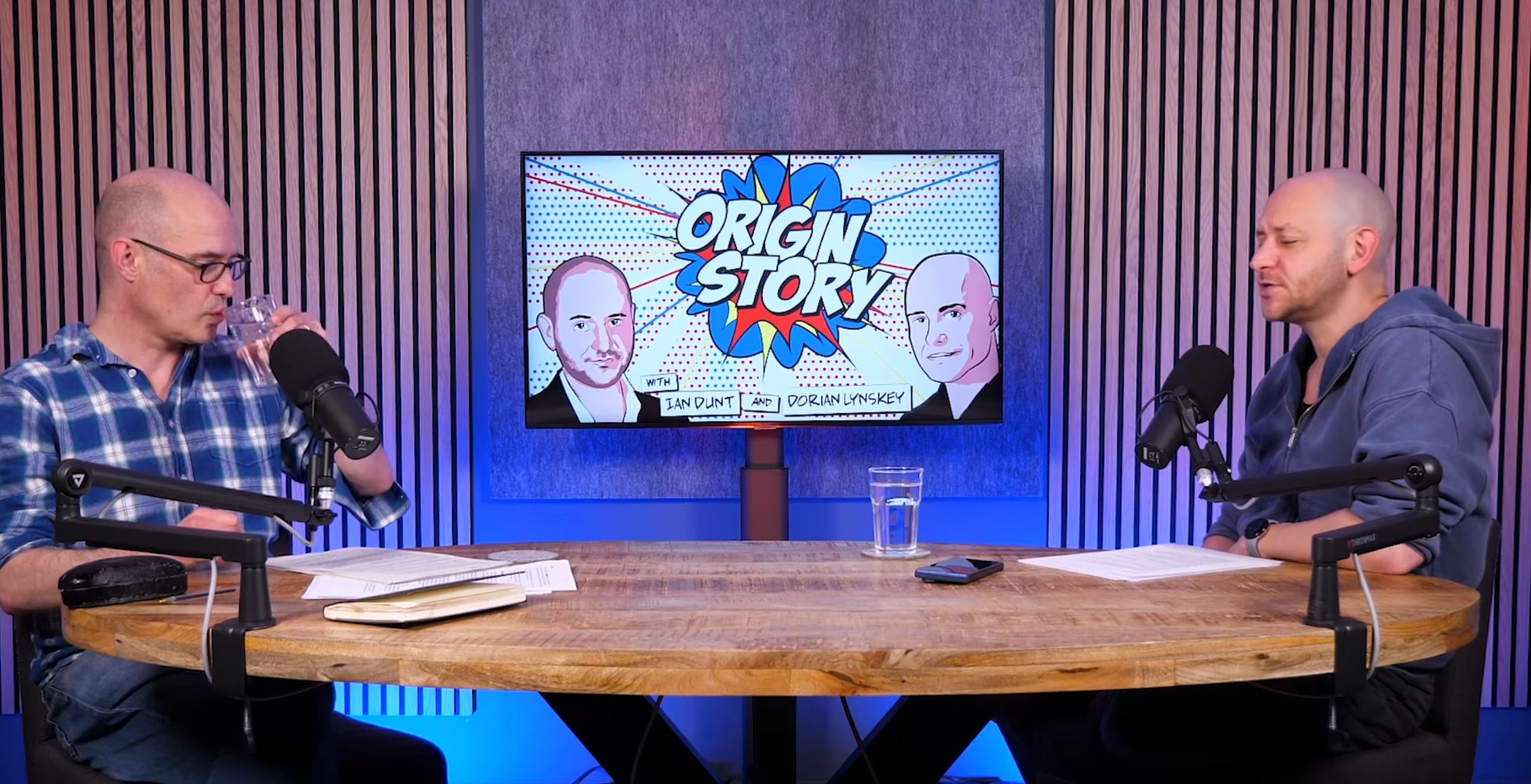
Now, 6 years later, Dunt and his co-host Dorian Lynskey have released the first of a two-part episode of their “Origin Story” podcast which attempts to recount a potted history of the last couple of decades of the gender wars, centred on JK Rowling, all to answer the following questions:
What can Rowling’s early life tell us about the path she has taken over the last decade? What is her relationship to fame and fandom? Why did the question of trans rights become all-consuming? What do gender critical feminists believe? And why can people not even agree on what words to use? It’s a story of obsession, polarisation, celebrity, Twitter and how people can radically change.
I don’t have a problem with people disagreeing with me - in fact, it is pretty foundational to the human experience that we aren’t all the same. What I do have a problem with though is when people’s disagreement is based on misunderstanding or misrepresentation - and when two liberal podcasters position themselves as understanders and explainers, they open themselves up to criticism when they misunderstand or misrepresent. And having listened to it, In my view there is no serious attempt to actually understand the subject or the positions advanced. What there is is the sort of superficial summary you can get by skimming Wikipedia and taking it at face value. Key points are glossed over or ignored entirely, negative phrasing is used throughout to frame positions the hosts evidently disdain, a typically American-centric focus is given to defining landmark events while far more significant domestic milestones don’t even get a mention. It is not hard to figure out the answer to the question “what do gender critical feminists believe”, yet over the course of an hour, the hosts simply cannot bring themselves to do it.
Which is surprising, given how straightforward it is. “Gender” is the name feminists adopted to refer to socially-constructed sex stereotypes, which are largely oppressive and harmful. By the meaning of the feminists who coined the term “gender-critical”, to be critical of “gender” is to be critical of sex-role stereotypes. And because to be critical of sex-role stereotypes is so fundamental to feminism, referring to oneself as a “gender-critical feminist” is so tautological that many radical feminists rejected it at the time. That’s why it is so important to understand that the phrase only came into existence in response to the use of “TERF” as a violent and dehumanising insult against feminists.
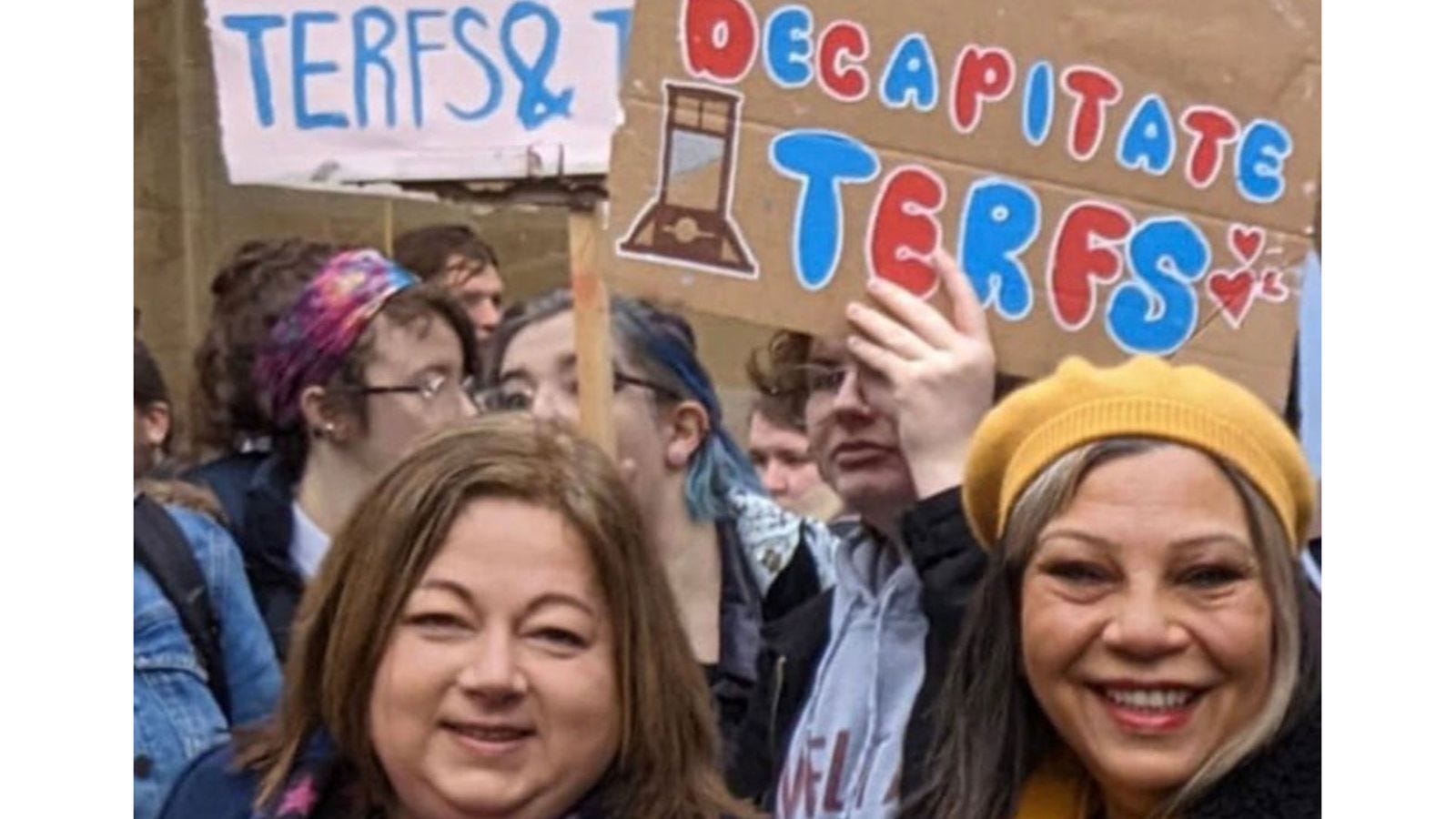
This is not all that complicated, and in their research the great podcast understanders have had it explained to them in very simple terms by Sarah Ditum (who has since published a pretty exhaustive takedown of the podcast):
There’s a piece called An Oral History of the Gender War. And in it one of them Sarah Ditum says it was an alternative terminology by which to reject being branded anti-trans or TERFs. “I and the women I shared intellectual ground with were not against trans people. We were critical of gender as a concept.”
Yet even when they accidentally quote an exact definition, they cannot grasp it, preferring instead to mither as the understanding slides off them:
But it’s very hard to separate those two things considering that without gender identity, you know, how do trans people make sense, right? How do they see themselves? Right? I don’t think you can separate the people. One of the people in this piece compares the redefinition of women by gender rather than sex to gaslighting and abuse. It’s very hard to not feel therefore that you are criticizing the people.
They seem unable to make the leap from what feminists are critical of - sex-role stereotypes - to what the term “gender identity” must therefore mean. Because if gender is sex-role stereotypes, then gender identity is all about one’s relationship to those culturally mediated stereotypes. A man claiming to have the “gender identity” of a woman means that they are embodying the very sex-role stereotypes that feminists seek to challenge. Reducing “woman” or “man” to the culturally-mediated behaviours and performance that we stereotypically expect of each sex is regressive and conformist, and not progressive.
The great liberal understanders are so wedded to the idea that they are progressive, and that “trans people” are also progressive, boldly challenging gender norms, they simply cannot grasp that the whole idea of “being transgender” reifies gender norms.
As Pulitzer-winning trans author Andrea Long-Chu said in 2018:
The TERF position that I would through transition be solidifying and reproducing normative gender roles—I find that argument completely convincing. I mean I think it’s completely right, because I know that it’s right, because it’s the thing that I want! Like, I’m not interested, actually, not at all interested in dismantling gender.
It is, again, really very simple and I am always curious as to what it is in the minds of supposedly intelligent people that stops them from grasping this. The idea that “being transgender” - and through that, cementing and solidifying gender roles - is somehow more progressive than attempting to dismantle gender in the first place is so deeply entrenched that they simply cannot allow themselves to understand the contradiction. So it is not them who are missing something, but gender-critical feminists who are simply unkind, using bad and distasteful language. So mean and distasteful are they in their language, that it is actually ok to refer to them as TERFs, to dehumanise them, to ridicule their words, to speculate that whenever they may have been “nice” or “moderate” in the past it was really covering up the nastiness they would later reveal.
Dozens of times the hosts use negative terms in their own voice about JK Rowling, Julie Bindel, Magdalen Berns, Victoria Smith - everyone they disagree with, laying bare their own biases. Cartoonish, controlling, thin-skinned, viciously transphobic, hostile, toxic, ugly, unpleasant, and on and on and on. I imagine they don’t even realise they are doing it. I imagine that if you were to point out the similarity to men in the early 20th century describing suffragettes as shrill harpies, they would fail to see the parallels. Dunt and Lynskey take offence at Magdalen Berns’ videos stating that no lesbian has a penis, demonstrating that drawing attention to simple differences between the sexes in basic terms a child can understand is distasteful to them.
But when did the hosts themselves come to believe a lesbian can have a penis? Because I can tell you now, there was definitely a point where they knew lesbians were female and a man claiming to be a lesbian trapped in a man’s body was grossly sexist and offensive. So, who told them otherwise and why did they believe it? Or do they not believe it, and just think it is rude to say what everyone knows to be true?
At another point they mention Janice Raymond’s book, The Transsexual Empire:
[Lynskey] You’ve got Janice Raymond’s 1979 book, The Transsexual Empire. What a terrifying title. Uh describes transition as a form of rape and says the problem of transsexualism would best be served by morally mandating it out of existence.
[Dunt] Wow.
Now, it is not necessary for them to like or defend Raymond’s book, but if they are going to position themselves as explainers and understanders of controversial and complicated subjects, they should at least have read the source material, and the manner in which this is presented makes it absolutely clear one of two things:
They have not read it
They have read it, and still think that selectively and breathlessly presenting it like this is a fair way of explaining to an unfamiliar audience what it is about
Neither of those is good.
What Raymond was attacking was the sexist social conditions that lead men to believe they cannot behave or dress the way they want to behave while still being men, while simultaneously turning women into objects of fetishisation. It is the sexist social conditions she wants to morally mandate out of existence, not the individuals.
Raymond’s whole point was that expansive human expression is a good thing, and it is regressive sex-role stereotyping that prevents people from expressing themselves in ways they wish. The problem as she saw it was that men’s objectification of female sex stereotypes, and constrictive ideas of male sex stereotypes, lead some men to think that in order to look and act the way they want to, they must “become” the opposite sex - which simply reifies those stereotypes, and the world would be a much better place if we actually just challenged those stereotypes.
And as for the wow-so-scary title - the “Empire” she referred to is the medical-institutional complex that reinforces and facilitates the delusion of actually being able to change your sex, and thus which exploits the vulnerable people who are so damaged by rigid gender norms that they seek drugs and surgery in order to alleviate the deep pain this sick society causes them. The “Empire” is capitalist exploitation of misery, and she advocated consciousness-raising and peer-support in order to free individuals - and ultimately society - from the restrictive gender stereotypes that created that misery in the first place.
They explain none of this, and understand none of this.
What they have done instead is recycle an activist talking point, not come with an opinion or insight that is truly their own. Indeed, the longstanding misrepresentation of Raymond is absolutely totemic of the way this argument has played out for decades - Raymond is a mean nasty bitter old hag who can’t just be kind, and cruelly points out the men who so desperately want to be women, aren’t, and what she actually says is irrelevant when you can just take a bad-sounding snippet out of context and present it for shock value.
In taking an academic text almost five decades old completely out of context and presenting it in the most inflammatory way possible, while tutting and shaking their heads at how scary the title is and how threatening her words sound, they engage in exactly the “moral panic” behaviour they purport to criticise.
There is so much that could be said by an interested podcaster about how there has been years of increasingly widespread meltdown over this issue, at all levels of society. The us-vs-them mentality created by othering labels such as “TERF”, which turn the target into something subhuman and scornful, and renders their reasonable positions unsayable and unthinkable. The way that men have utterly dominated our technological infrastructure and thus how information is even communicated in the modern age - and consequently as moderators and administrators who have been able to shape what thoughts are even permissible. The algorithmic recommendation engines that fuel division on social media, creating ad-hoc echo chambers that are the perfect environment for radicalisation. The deep, sexist disregard for the opinions of women perceived as “old” or “unkind”. The impact of pervasive, streaming pornography. How the constant use of “trans-exclusion” as a shorthand for, very specifically, “transwomen being excluded from female things” is so deeply revealing of the linguistic male default that it perfectly demonstrates that transwomen are male. Why Mumsnet was practically a lone holdout and so important in early opposition managing to organise without simply being banned like in other - male-dominated - online forums.
Or, for something the former “Remainiacs” podcasters might have thought to have an opinion on, how Brexit completely paralysed the British establishment after 2015 and bought time for scrappy women’s groups starting from absolutely nothing to get some serious resistance to GRA reform off the ground, rather than having self-id nodded through parliament at the behest of well-funded lobby groups.
All of this would be much more informative, should some actual journalist choose to do a real “origin story” of how sex and gender became such a divisive subject.
At the start of this I pointed out Ian Dunt’s liberal-minded defence of Helen Lewis, who was so clearly unfairly treated for engaging in absolutely legitimate debate. I want to end by drawing attention to what has happened to French feminist, Dora Moutot on the very same day the great liberal understanders released their podcast.
Dora Moutot has been criminalised by a court in France for the statement “as women, we are compelled to be wary of people with penises”. I would urge everyone to read her story, because she was as kind and moderate in her language as possible, talking specifically about the instance of placing male rapists in female prisons - which Dunt and Lynskey single out as an obvious madness - and all couched in all the nicest, most middle-of-the-road terms about not targeting individuals, and attempting to find common ground:
No, for me, these aren’t things to be opposed to; we need to find common ground. The problem with finding common ground today lies in certain specific areas. For example, in sports: today, there are a number of trans women, formerly male, who compete against women in sporting events. And sometimes, simply because they have a different physique, they win.
We also have a problem, for example, in prisons. So, in some countries — it will be in the United States, in California or in England — we will find ourselves with men who have sometimes committed murders on women, or rapes, who will be transferred first to a men’s prison, and then they will do a “gender affirming” program [mime of quotation marks], so they will make a transition in prison, they will become women in prison, administratively speaking, and they will be transferred to women’s prisons.
We find ourselves, I have to say, with some men who rape their fellow inmates. I’m not saying that all trans people do this, far from it, but we, as women, have to be wary of people with penises.
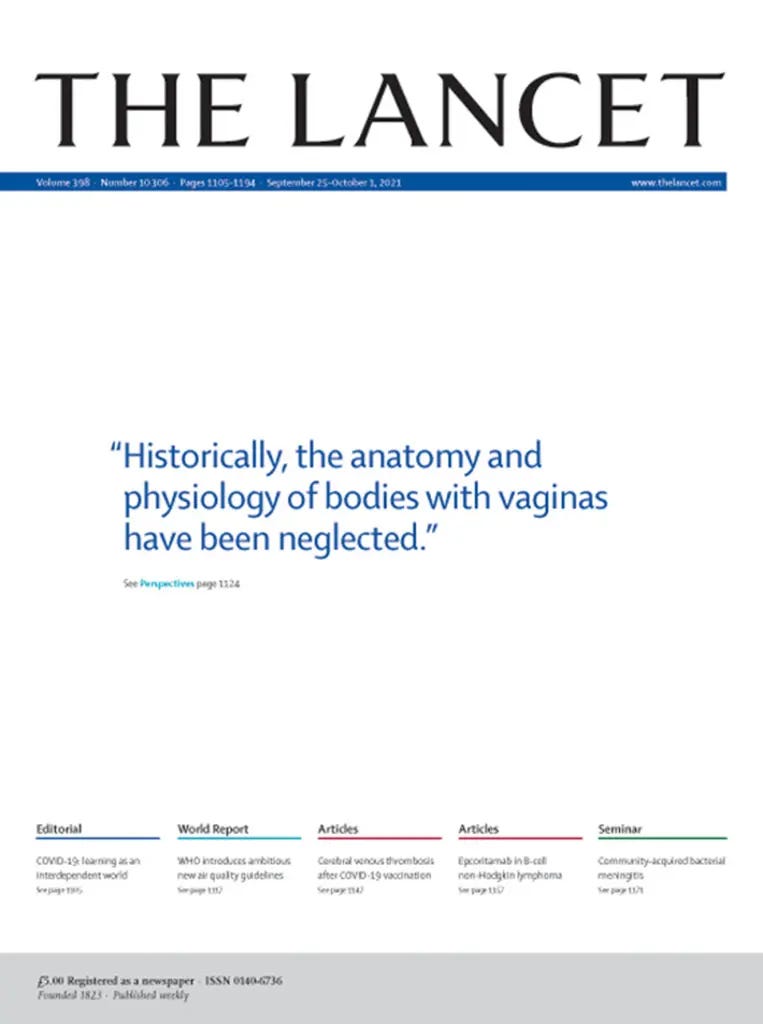
In fact, her phrasing was itself a concession to the language demanded by activists. Rather than outright saying a transwoman is male, instead it is alluded to in terms of disembodied organs, all part of the long history in this subject of dehumanisation and dissociation of female human beings into parts - uteruses, breasts, vaginas. All part of a societal trajectory that led The Lancet, in 2023, to describe women as “bodies with vaginas” on its cover:
The truth is that there is no acceptable language, because the crime is to disbelieve. Moutot gave absolutely every possible concession and was still criminalised for not accepting, by implication, that transwomen are really women:
By referring to them as 'penis people' whom 'women' are 'forced to distrust', the defendant first assigns transgender women to their penis, that is, to their male sexual attribute of birth, while denying their female gender identity since they are opposed to 'women', the defendant thus implicitly considering that transgender women are not women
This is profoundly illiberal, and exactly the sort of thing that 2020 Ian Dunt would surely have condemned. It is the absurd but entirely inevitable endpoint of years of harassment and silencing, that women should now be criminalised for pointing out that men pose a threat to them.
And in the course of researching this podcast, the hosts ought to have shown an understanding of why the original Forstater judgement was just as illiberal, seeing as it made the mere belief that sex is real, binary and important something so unspeakably wrong that absolutely anybody could be fired if they were discovered to have those illegitimate thoughts in their head. Perhaps then they would have understood why Rowling felt it so necessary to intervene on this point, just as Dunt had once felt compelled to defend Helen Lewis. Perhaps then they would have understood why it was so important for it to be overturned on appeal, as it rightly was. Instead, they describe Rowling’s defence of liberalism as “the first step towards the mainstreaming of the anti-trans attitudes”.
I would have to ask where Dunt’s line of legitimate debate and acceptable speech sits today, six years on from the “abysmal” treatment of Helen Lewis. And if those spinning this “origin story” can’t see what was wrong with the original Forstater judgment, and can’t condemn the obvious injustice faced by Dora Moutot, perhaps those who can - like JK Rowling - aren’t the ones who have changed.